
Our Lady of the Novena
The patroness of Spanish actors has had her chapel in San Sebastián since 1631, after the miraculous healing of an actress on nearby Calle del León.
In the early 17th century, nearby Calle del León was home to one of Madrid’s mentideros, the gossip spots where people gathered for news: the one for comic actors and theatre managers. It stood next to the city’s most important playhouses, the Corral del Príncipe and the Corral de la Cruz, so the neighbourhood was always full of actors, writers and theatre folk.
That street is where the legend of the miracle of Our Lady of the Novena was born, a legend that, like all of Madrid’s, has several versions and many unknowns. It seems that in one of those houses an image of Our Lady of Silence was displayed for popular devotion. An actress, Catalina Flores, who had been left crippled after a difficult childbirth, made a novena to her.
On the ninth day she was healed. Word of the miracle spread and so many devotees came that a congregation and a chapel had to be founded in the neighbouring parish church of San Sebastián. The actors chose this Virgin as their patroness and paid the costs from their own pockets. So in 1631 the Congregation of Our Lady of the Novena of Spanish Actors was born, with a clear social purpose: to act as a mutual aid fund for the profession.
The painting
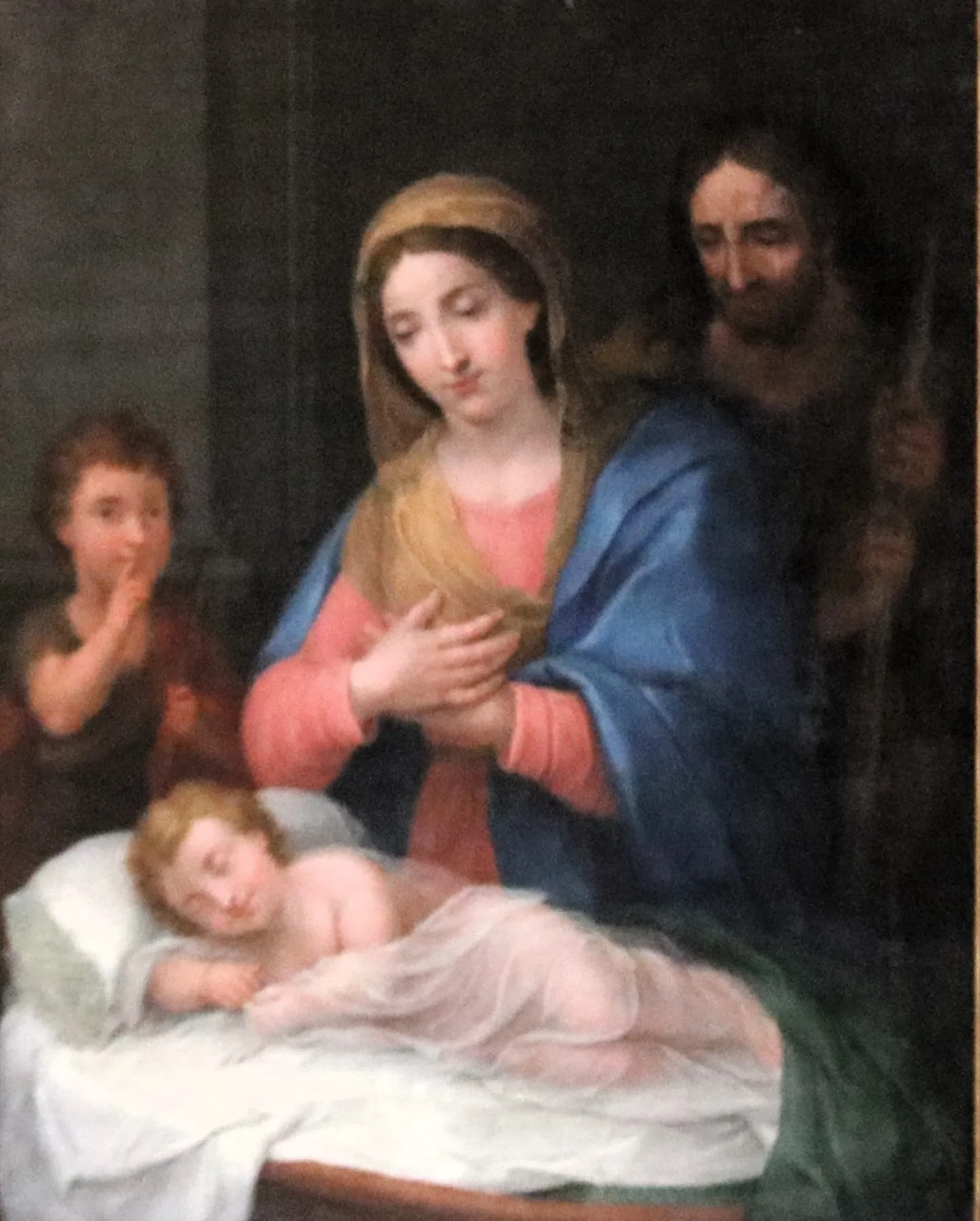
The image venerated on one of the altars is a canvas of the Virgin gazing at the sleeping Child, with Saint Joseph and the young Saint John, who raises a finger to his lips asking for silence. The original painting was vandalised while it was still in the street, and a copy was made afterwards.
On one occasion the Virgin was taken to the palace of the Countess of Chinchón, who was ill and recovered. The countess kept the painting and had a painter make an exact copy for the church. When she died, the original returned to the confraternity, which found itself with two identical canvases. To put an end to this practice, Pope Innocent X forbade the painting to leave the parish in 1651, on pain of excommunication. After the church was destroyed in the Civil War, the congregation recovered a replica thanks to the Artistic Recovery Service.
A curiosity: the Virgin herself headed the payroll in the theatre companies’ contracts, to the dismay of the composer Barbieri, who discovered it in the city archive. She was assigned the same salary as the leading actor or actress, and that sum was given as a donation to the confraternity.